
What is an AI agency and what does it do? 2026 guide
“I need AI in my company, but I don’t know where to start or who to call.” If that sounds like you, you’re looking for exactly this: an AI agency. Let’s walk through what it is, what it actually does — no fluff — and, above all, how not to get the choice wrong.
Definition: what an AI agency is (and isn’t)
An AI agency is a company that designs, builds, and ships custom artificial intelligence systems for other businesses. The key word is builds: it doesn’t sell you a license to closed software and walk away. It sits down with your specific case, builds the solution, and leaves it running inside your operation.
And what it isn’t: it’s not a marketing agency using ChatGPT to write posts, nor a consultancy that hands you a slide deck of recommendations and disappears. An AI agency writes the code, connects your tools, and takes responsibility for the thing working on Monday morning.
What an AI agency does: the services
In practice, almost everything an AI agency does fits into four buckets.
Custom AI agents
An AI agent is like an employee that never sleeps: it takes a request, decides what to do, checks your systems, and acts — or flags a human when something goes off-script. Customer support that actually resolves, lead qualification, internal assistants that search your documentation. Not a form in disguise: an agent that reasons about your context.
Process automation with AI
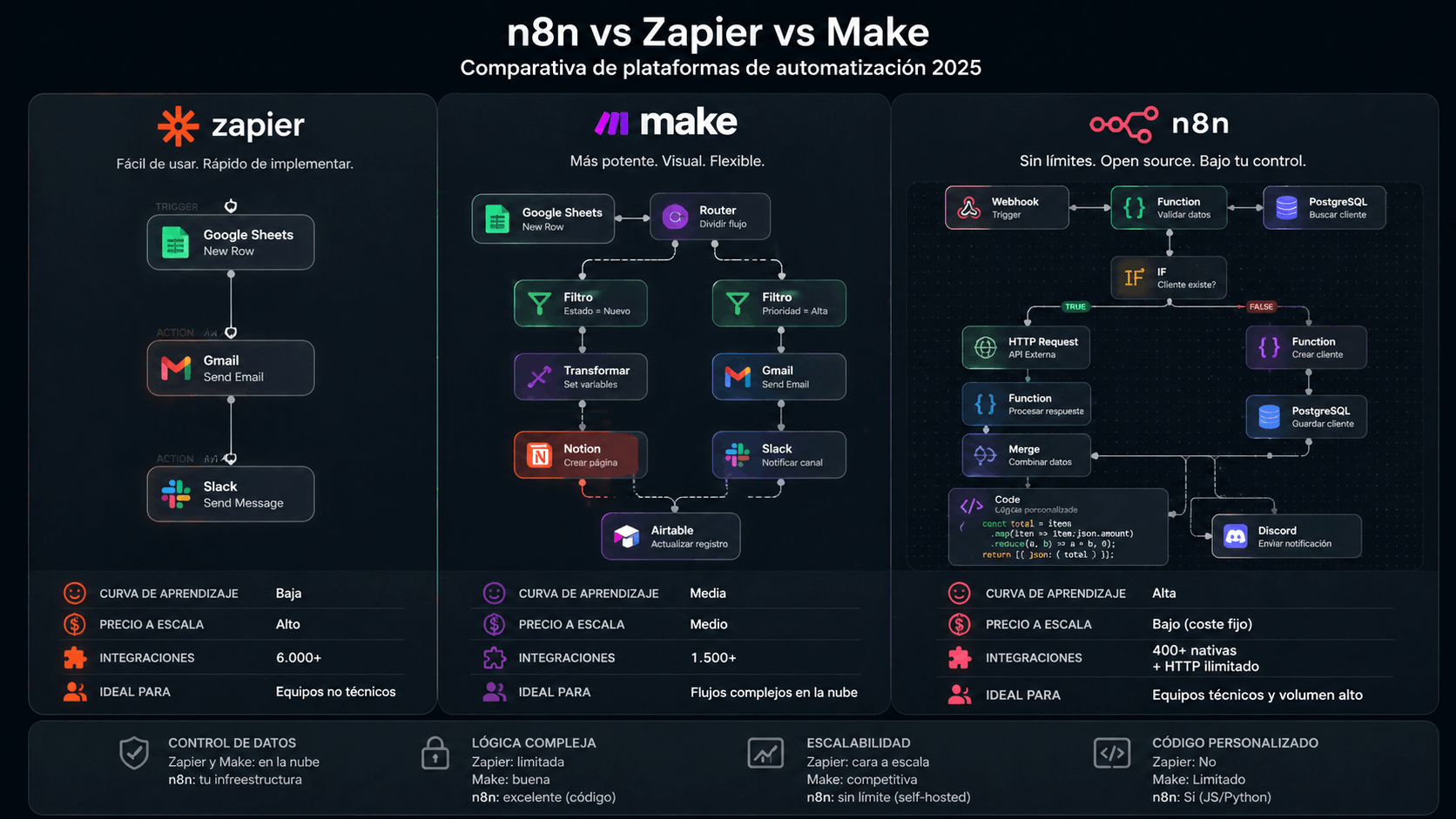
All that repetitive work someone does by hand today — copying data between apps, generating reports, moving information from one system to another — becomes a flow that runs on its own. This is where tools like n8n come in; if you want to go deeper, we have a comparison of n8n, Zapier, and Make.
Chatbots and virtual assistants for businesses
Support over WhatsApp, web, or whichever channel you use, available 24/7 and in multiple languages. Done right, it’s not a rigid button tree: it understands what the customer asks and resolves it or escalates. It’s one of the most common entry points to AI because the return shows up fast.
Integrating AI into your stack
AI doesn’t live alone. The value appears when it connects to what you already use: your CRM, your WhatsApp, your database, your internal tools. A big part of an AI agency’s job is exactly that glue — integrating, via API, systems that didn’t talk to each other.
How it differs from a marketing agency, a consultancy, or a software shop
It’s the most common mix-up, so let’s be clear:
- Marketing agency: uses AI as a tool for its own work (content, ads). It doesn’t build systems for you.
- Consultancy: tells you what to do. Valuable for deciding, but often it doesn’t touch the code or leave anything in production.
- Software shop: builds custom software, but not necessarily with AI or focused on automating your operation.
- AI agency: joins the two halves that matter — it decides what makes sense and builds it until it’s running.
The difference fits in one sentence: it hands you something that works, not a report.
When your company needs an AI agency
Not every company does, and we’d rather tell you. The signals that you do:
- Your team loses hours on repetitive, predictable tasks.
- You copy data from one app to another by hand.
- You answer the same questions over and over.
- You have data piling up that you don’t use to decide anything.
- You know “this could be automated,” but nobody internally has the time or the profile to do it.
If the bottleneck is operational and repeatable, it’s a candidate. If it’s strategic or creative, maybe what you need is something else.
How to choose an AI agency: a 7-point checklist
This is where most people get it wrong, because the market is full of hype. The criteria that actually matter:
- Real technical experience, not a sales pitch. Ask to see things they’ve built, not just pretty case studies on the website.
- Cases in production. A demo is easy. The hard part — and the one that matters — is working with real data, every day.
- Observability. How will you know if the system fails? A good agency sets up alerts and logs, not an agent that breaks in silence.
- Code ownership. Is the system yours, or are you tied to the agency forever? It should be yours.
- Maintenance and handover. They should train and document so your team doesn’t depend on them indefinitely.
- Honesty about trade-offs. If they promise magic with no downsides, be wary. Every system has limits, and a good agency tells you what they are.
- Focus on the problem, not the technology. They should start by asking what hurts, not by selling you the latest model.
And a step before all of this: before hiring anyone, it helps to know what to automate first. Mapping your processes with a technology roadmap is the way to do that.
How much an AI agency costs
There’s no single number, but there are three common models:
- Fixed-scope project: a defined scope at a fixed price. Good when the problem is clear.
- Monthly retainer: a fee for continuous evolution and support. Good when you want to build in phases.
- Hourly: a block of hours. Flexible, but it requires you to have a clear direction.
The mistake is looking only at the hourly rate. What matters is the return: how many hours of manual work the system removes, or how much revenue it unlocks. An agent that saves your team 40 hours a month pays for itself. And the reverse is just as true: cheap that doesn’t work is the most expensive thing there is.
Use cases by sector
The same technology solves very different problems depending on the sector: clinics and salons automating bookings and reminders over WhatsApp; firms extracting data from documents; ecommerce qualifying and serving leads around the clock; finance teams automating reports across systems. The common thread isn’t the sector — it’s having a repeatable process that eats people’s time today.
At IA Operators we’re exactly this: an AI agency that builds and ships — agents, automations, and chatbots, with a focus on real production. If you want to see how we approach it, take a look at our AI agency service, or tell us what’s eating your time and we’ll tell you whether it’s worth automating — no strings.
Frequently asked questions
What exactly is an AI agency?
What services does an AI agency offer?
How is it different from a marketing agency or a consultancy?
How much does hiring an AI agency cost?
How do I know if my company needs an AI agency?
Next steps
Ready to act?
Diagnosis, prioritization and execution — no hand-offs. The same team that maps the problem builds the solution.

Luiz Brazão
Founder, IA Operators
Years leading teams across mid-size and large companies. Founded IA Operators to diagnose technology ecosystems, prioritize what moves the needle, and build solutions — no hand-offs between those who think and those who build.
LinkedIn ↗