
Blog
What is a technology roadmap: a guide for mid-market companies
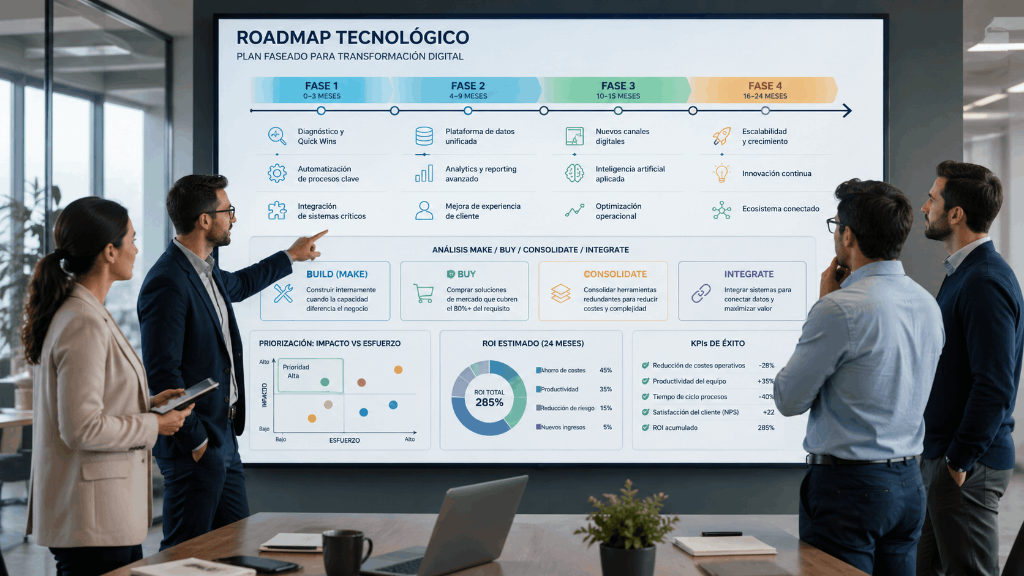
A technology roadmap is a phased plan that defines what to build, buy, integrate, or consolidate in a company’s digital ecosystem, with prioritization criteria based on business impact, implementation effort, and estimated ROI.
It’s not a project list. It’s not the IT backlog. It’s the translation of strategic business vision into an actionable technology plan: what to do first, why, how much it will cost, and what return it will generate.
Why most companies don’t have one
According to McKinsey, 70% of digital transformation projects fail to meet their objectives. One of the most frequent causes: companies execute technology initiatives without a clear prioritization criterion. They build what the vendor sells, what the IT department has time for, or what the CEO read in an article over the weekend.
The technology roadmap is precisely the tool to avoid this.
A good roadmap doesn’t answer “which technology is better?” — it answers “which digital capabilities does this specific company need to achieve its business objectives in the next 12–24 months, and in what order does it make sense to build them?”
What a technology roadmap contains
1. Target architecture vision
The destination: what the company’s technology ecosystem should look like in 12–24 months. Not an abstract ideal architecture, but a realistic one for this business, with its budget constraints, team capacity, and operational complexity.
2. Current state assessment
If the company already has a systems audit, this section is the foundation. If not, a simplified version is built here: inventory of critical systems, map of main integrations, and immediate risk analysis.
3. Make / buy / consolidate analysis
For each identified initiative, the evaluation covers:
| Option | When it makes sense |
|---|---|
| Buy | A market solution covers 80%+ of the requirement at reasonable cost |
| Build | The requirement is sufficiently differentiating that custom development creates competitive advantage |
| Consolidate | Two or more tools are doing the same thing and redundancy can be eliminated |
| Integrate | The systems are right but not connected — the value is in the data, not the tool |
This analysis is the heart of the roadmap. It’s where expensive decisions are avoided: buying a massive platform when connecting existing systems would have been enough, or building something custom when a SaaS solves it for €200/month.
4. Initiatives prioritized by impact and effort
Each roadmap initiative is rated on two dimensions:
- Business impact: how much does it move the needle? Cost savings, capacity increase, risk reduction, enabling new revenue streams?
- Implementation effort: technical complexity, time, cost, dependencies on other projects
The resulting matrix determines execution order: first what has high impact and low effort, then the rest according to strategic criteria.
5. Phased plan with estimated ROI
The roadmap is delivered in concrete phases, not as a wish list. Each phase has:
- Included initiatives and their sequence
- Investment and time estimates
- Expected ROI (cost savings, productivity, risk reduction)
- Dependencies between initiatives (what needs to be resolved before executing what)
- Tracking KPIs to measure whether the phase achieved its objective
How to create a technology roadmap
Step 1 — Understand business objectives
The roadmap doesn’t start with technology. It starts with business: what are the company’s growth objectives, which processes are bottlenecks, where is margin being lost, what are the most urgent operational risks.
This conversation needs business people, not just the IT team.
Step 2 — Document the current state
If a prior systems audit exists, use it as the foundation. If not, build a simplified version: inventory of critical systems, map of main integrations, and immediate risk analysis.
Step 3 — Define the target architecture
With business objectives clear and current state documented, define where the technology ecosystem needs to go. Not the perfect architecture — the sufficient architecture for the next 12–24 months.
Step 4 — Identify and prioritize initiatives
The gap between current state and target architecture is the list of initiatives. Each is analyzed with the make/buy/consolidate framework and prioritized by impact and effort.
Step 5 — Build the phased plan
Initiatives are sequenced respecting technical and business dependencies. Investment and ROI are estimated for each phase. Success KPIs are defined.
Step 6 — Executive validation session
The roadmap is presented to C-level or the transformation committee. Not to approve every technical decision — to align technology priorities with business strategic priorities.
What a technology roadmap is not
It’s not a list of technologies to deploy. A roadmap doesn’t start with “we’re going to implement an ERP, a CRM, and a CDP.” It starts with “we need to reduce the sales cycle by 30% and eliminate spreadsheet dependency in operations reporting.” Technology is the means, not the end.
It’s not the IT backlog. The backlog manages short-term technical team work. The roadmap aligns technology investment with business strategy over 12–24 months.
It’s not a document updated annually that nobody reads. A useful roadmap is a living tool. It changes when business priorities change. When an initiative completes, the next enters execution.
When does it make sense to do a roadmap before executing?
The usual temptation is to go directly to implementation: “we know we need to automate X, when do we start?” The problem is that without a roadmap, you execute the most urgent initiative, not the most strategic one.
Doing the roadmap before executing makes sense when:
- There are several technology projects in the queue without a clear criterion for ordering them
- The company has a limited budget and needs to maximize the return on every euro
- There are dependencies between projects: building A without having solved B will create duplicated work
- The IT team and business team aren’t aligned on priorities
In companies with fewer than 15 systems and a very concrete, delimited problem, a full roadmap may not be necessary — going directly to implementation can make more sense. But beyond a certain complexity, executing without a roadmap costs more than the roadmap itself.
The roadmap as an internal alignment tool
A non-obvious consequence of the roadmap creation process is that it aligns internal stakeholders. The process of defining priorities forces conversations that many organizations never have: what matters more, growing into new markets or consolidating the current operation? Does sales or operations have priority in the next technology investment?
The roadmap makes visible what was previously implicit. And that, by itself, already has value.
Frequently asked questions
What is a technology roadmap?
A technology roadmap is a phased plan that defines which systems to build, buy, integrate, or consolidate in a company's digital ecosystem, with prioritization criteria based on business impact, implementation effort, and estimated ROI. It's the translation of strategic business vision into an actionable technology plan.
How is a technology roadmap different from an IT plan?
A traditional IT plan focuses on infrastructure: servers, networks, security, licenses. A technology roadmap starts from business objectives and defines which digital capabilities the company needs to achieve them, and in what order to build them. It's strategy, not just operations.
When does a company need a technology roadmap?
When it has clarity on which problems to solve (from a prior audit) but needs to prioritize what to tackle first. Also when there are parallel technology projects without a clear sequencing criterion, or when technology investments need to align with the year's business objectives.
How long does it take to create a technology roadmap?
For companies of 50–500 people, between 4 and 6 weeks. The process includes business vision workshops, target architecture analysis, make/buy/consolidate evaluation for each initiative, and building the phased plan with estimated ROI.
Does the technology roadmap lock you into executing with the same vendor?
No. A well-made roadmap is vendor-independent. Deliverables are yours in editable format. You can execute internally, with another partner, or with the team that created it. The recommendation that matters is the one that best fits your context, not the one that generates the most commission.
Next steps
Ready to act?
Diagnosis, prioritization and execution — no hand-offs. The same team that maps the problem builds the solution.

Founder, IA Operators
LinkedIn