
The 7 AI trends that will create the biggest business opportunities in 2026

Artificial Intelligence is no longer a trend.
It has already become infrastructure.
While many companies are still experimenting with ChatGPT and building their first virtual assistants, the most advanced organizations are entering a new phase: building autonomous systems capable of executing complete business processes.
The 2026 market data reveals a profound transformation in the skills most sought after by companies, in the fastest-growing technologies, and in the profile of the professionals capturing the biggest opportunities.
If you work in technology, marketing, automation, or want to build an AI-based business, these are the trends that deserve your attention.
1. We are entering the era of AI Agents
In recent years, much of the market focused its efforts on tools capable of answering questions using a company’s internal documents.
Now the focus has shifted.
Companies want systems capable of taking action.
An AI agent can:
- Read emails
- Update CRMs
- Run automations
- Generate reports
- Query databases
- Make decisions within defined rules
- Coordinate other agents
Instead of simply answering questions, these systems do the work.
This shift is creating a new professional category: specialists in the architecture and implementation of AI agents.
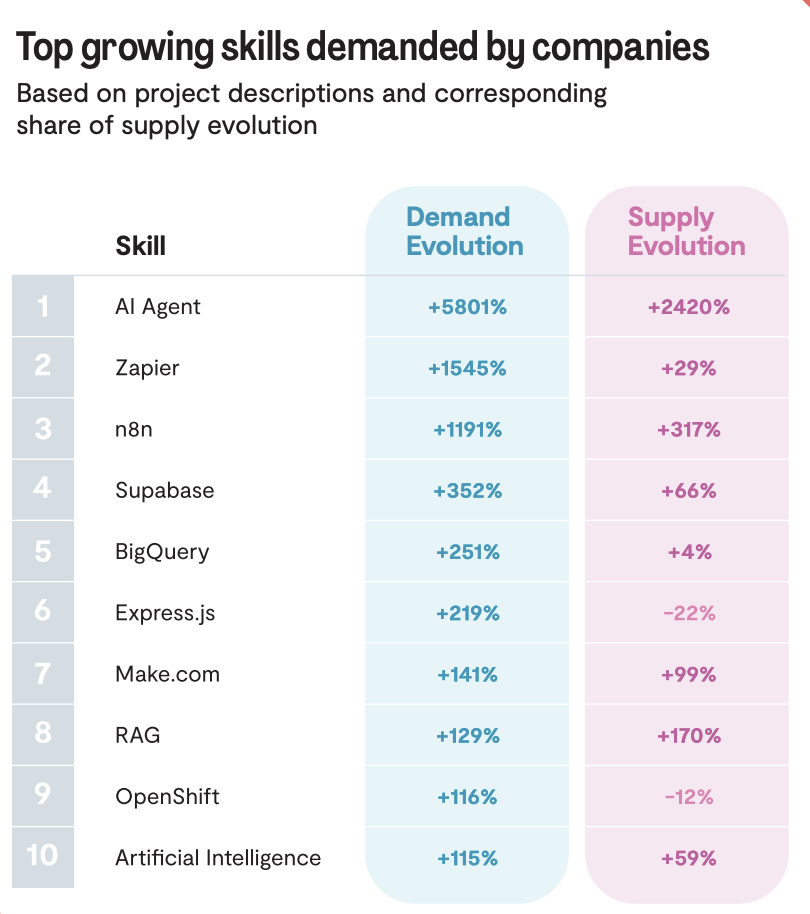
Growth of the technologies most in demand by companies in 2025. AI agents lead by an enormous margin over all other categories.
2. n8n is becoming a strategic skill
For many years, learning a new programming language was the safest way to increase your professional value.
Today that is no longer necessarily true.
Automation tools like n8n, Make, and Zapier are growing at a much faster pace than traditional technologies.
The reason is simple.
Companies are not buying code.
They are buying results.
They want to integrate systems, automate processes, and build more efficient operations.
In this context, n8n has become one of the most important platforms on the market because it combines:
- API integration
- Visual workflows
- Connection with LLMs
- Complex automations
- Self-hosted deployment
- Enterprise flexibility
Interestingly, many people are still focused only on learning prompts.
Meanwhile, companies are hiring professionals capable of building complete systems using AI and automation.
This is exactly why n8n has become one of the pillars of the training inside IA Operators HUB.
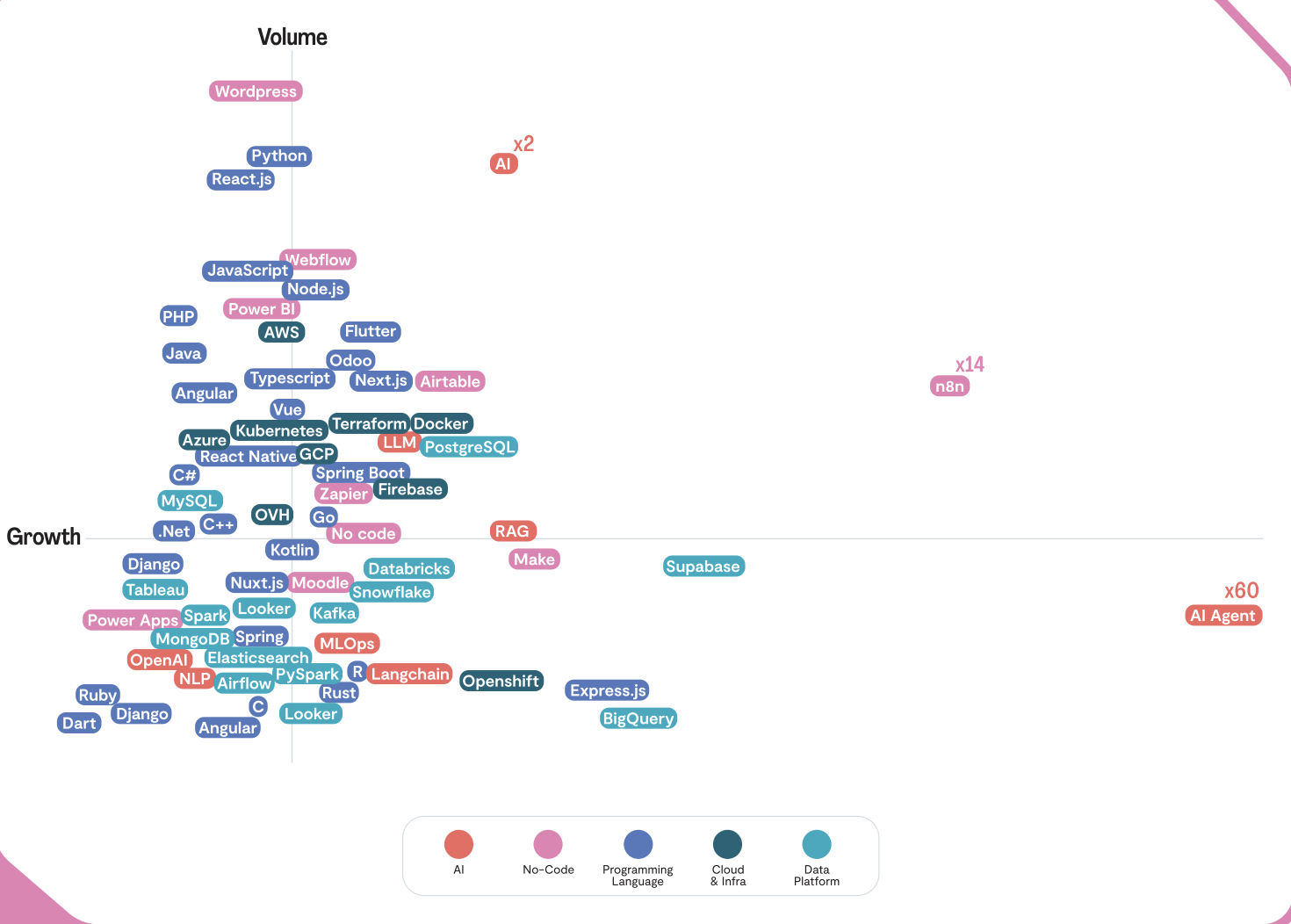
The growth of n8n and AI Agents far surpasses traditional technologies.
3. The programmer is becoming an orchestrator
For decades, the main value of a technical professional was their ability to write code.
This scenario is changing rapidly.
Today, the differentiator lies in the ability to coordinate:
- AI models
- APIs
- Databases
- Automation tools
- Enterprise systems
The most valuable professional is not necessarily the one who codes the most.
It is the one who can combine different technologies to solve real problems.
In other words:
The market is migrating from the builder to the orchestrator.
Professionals who manage to develop this systemic vision will have a significant competitive advantage in the coming years.
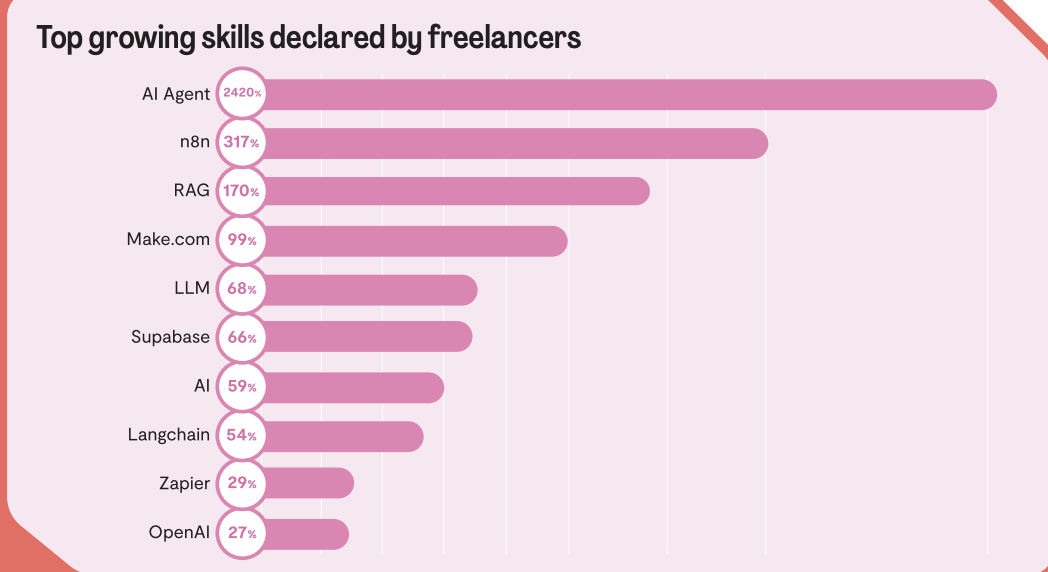
Professionals are already migrating rapidly toward skills related to AI and automation.
4. Artificial Intelligence is no longer a specialty — it has become a requirement
A few years ago, working with AI was something reserved for data scientists.
Today the situation is completely different.
Artificial Intelligence has become part of the daily routine of:
- Developers
- Analysts
- Consultants
- Marketing professionals
- Operations specialists
- Solution architects
The market is no longer asking whether you know AI.
It is assuming you do.
The question now is:
Can you use it to generate results?
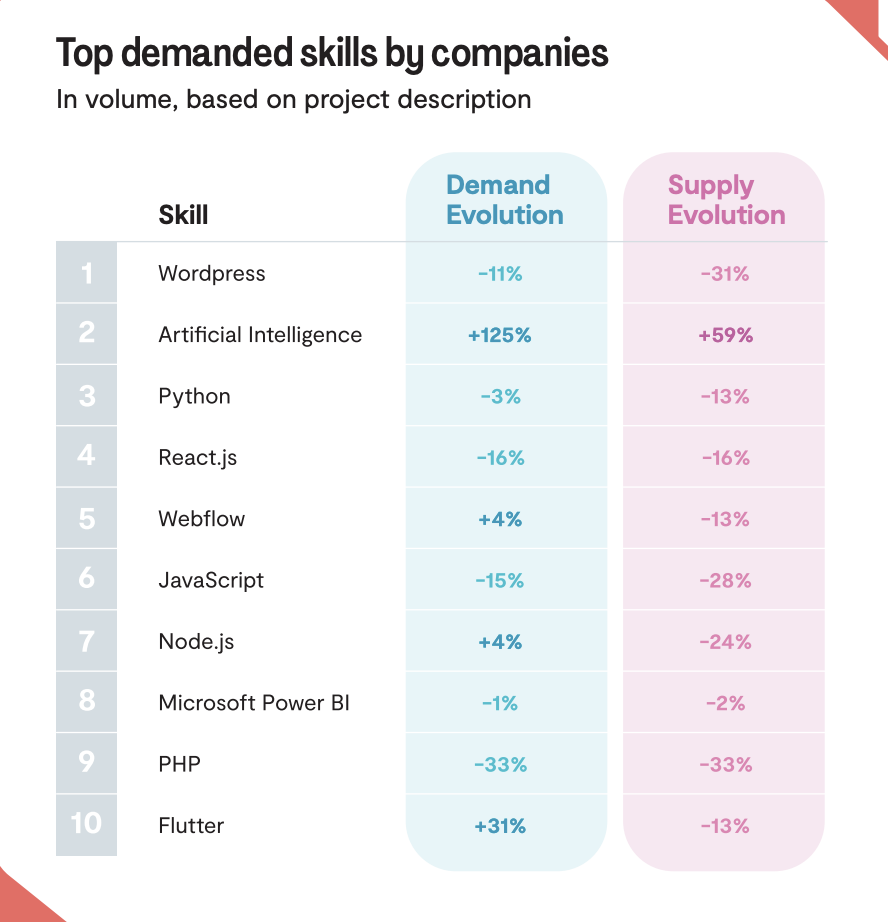
Artificial Intelligence already ranks among the most in-demand skills on the market.
5. A new profession emerges: AI Solution Architect
One of the consequences of the AI explosion is the rise of a new professional profile.
Companies are looking for people capable of:
- Identifying opportunities
- Mapping processes
- Choosing technologies
- Designing solutions
- Coordinating implementation
This professional does not need to be the best programmer.
But they do need to understand technology, business, and automation.
In practice, they act as a bridge between the company’s goals and the technical solutions.
This is exactly the profile emerging in thousands of companies around the world.
6. The cost of AI has become a real concern
During the early phase of the AI revolution, the focus was on innovation.
Now the focus is on efficiency.
As companies increase their use of models, agents, and automations, costs grow rapidly.
AI infrastructures can cost many times more than traditional systems.
That is why a new discipline is gaining momentum: FinOps.
FinOps combines engineering, operations, and financial management to control technology costs.
Although still little known, this will be one of the most important areas of the next decade.
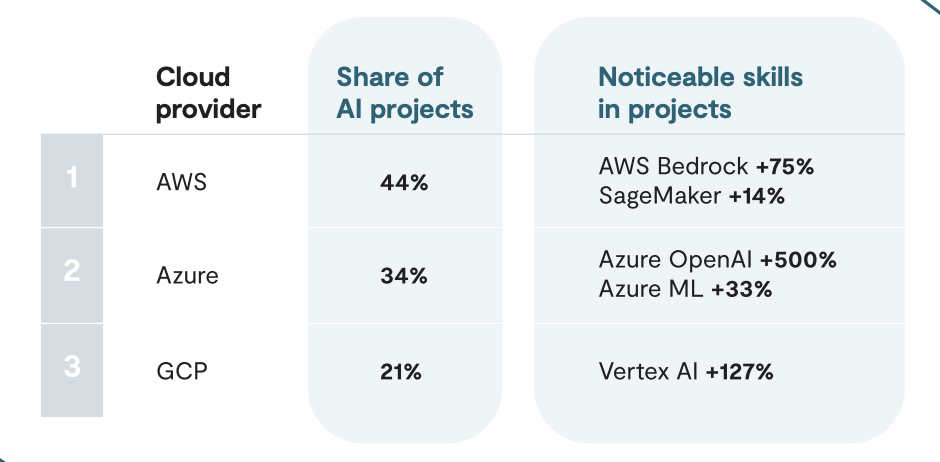
The accelerated growth of AI costs is creating a new demand for financial management of technology.
7. The competitive advantage is shifting to those who know how to integrate
Many people believe AI will replace professionals.
The reality seems different.
What is happening is a growing appreciation for professionals who can integrate technology into business processes.
The competitive advantage is not in having access to AI.
Everyone has it.
The advantage lies in knowing how to use it to solve real problems.
Companies that manage to integrate AI, automation, and business processes will achieve productivity gains far superior to their competitors.
The same applies to professionals.
How to prepare for this shift
The good news is that most of these skills are still at the beginning of the adoption curve.
We are not talking about a saturated profession.
We are talking about a transformation that is still accelerating.
Tools like:
- n8n
- OpenAI
- Claude
- Supabase
- Make
- LangChain
make it possible to build extremely sophisticated solutions without needing years of experience in traditional development.
The challenge becomes understanding processes, identifying opportunities, and learning to connect the right tools.
It was precisely to accelerate this learning curve that we created the IA Operators HUB 60-Day Challenge.
During the program, we show step by step how to build automations, AI agents, and solutions used by real companies.
Conclusion
The data points in a very clear direction.
The next big opportunity in Artificial Intelligence is not in using isolated tools.
It is in building systems.
The most valued professionals will be those capable of combining AI, automation, data, and business processes to generate concrete results.
The question is no longer whether AI will transform the market.
It is already transforming it.
The question is:
Do you intend to just watch this change, or do you intend to take part in it?
If you want to develop skills such as AI agents, n8n, automation, solution architecture, and the implementation of intelligent systems, check out the IA Operators HUB 60-Day Challenge.
👉 https://www.skool.com/ia-operators-hub-4762/about
The best time to start was yesterday.
The second best time is today.
Next steps
Ready to act?
Diagnosis, prioritization and execution — no hand-offs. The same team that maps the problem builds the solution.

Luiz Brazão
Founder, IA Operators
Years leading teams across mid-size and large companies. Founded IA Operators to diagnose technology ecosystems, prioritize what moves the needle, and build solutions — no hand-offs between those who think and those who build.
LinkedIn ↗